

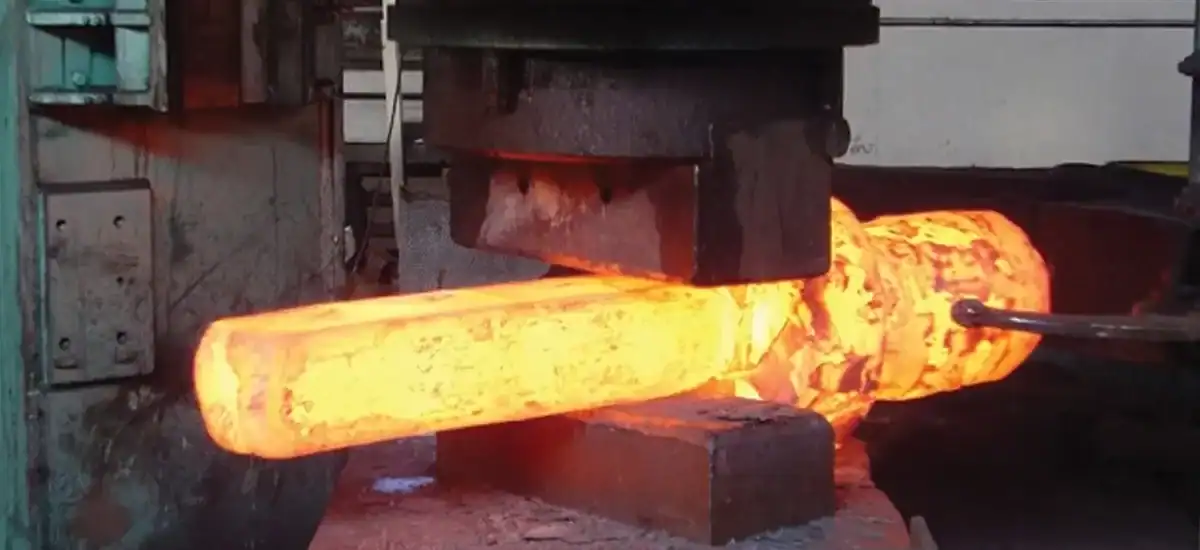
What Is Open Die Forging?
Open die forging, also called free forging, is a hot forging process in which metal is shaped between flat or simply contoured dies that do not fully enclose the workpiece. Because the metal is free to flow laterally during forging, the process suits large components and custom shapes that closed die tooling cannot economically produce.
It is one of several routes within the broader forging process, and the one that handles the largest sections.
The workpiece is heated to its forging temperature and then deformed through repeated, controlled compressive blows from a hammer or press. Between strokes, the operator repositions and rotates the workpiece to build up the required geometry progressively. This makes open die forging well suited to shafts, cylinders, discs, rings, and blocks, often in the several-hundred-kilogram to multi-tonne range.
How the Open Die Forging Process Works
The billet is heated in a furnace to a temperature above the metal’s recrystallization point, typically between 1,100°C and 1,250°C for carbon and alloy steels. Once at temperature, it is placed between the dies and worked through successive compressive strokes.
Unlike closed die forging, the dies do not carry the impression of the finished part. Instead, the final geometry is achieved through skilled manipulation of the workpiece and controlled deformation. Common operations include upsetting (reducing height to increase diameter), drawing out (increasing length by reducing cross-section), and piercing.
Advantages of Open Die Forging
Open die forging offers several benefits for large and demanding components:
- Large part capability — the process can produce components far larger than closed die forging equipment can handle
- Refined grain structure — the compressive work refines the internal grain flow, improving strength, fatigue resistance, and toughness
- Reduced internal defects — forging closes voids and porosity present in the original billet, producing a sound, dense component
- Tooling flexibility — because no dedicated impression dies are required, custom and low-volume parts can be produced cost-effectively
- Material versatility — the process works across carbon steel, alloy steel, stainless steel, and other engineering alloys
Where a part could reasonably go either way, we have set out open die and closed die forging compared directly, including the volume at which tooling cost starts to pay back.
Limitations
Open die forging holds looser dimensional tolerances than closed die forging, so components generally require post-forging machining to reach final dimensions. It is also more labour-intensive per part, which makes it better suited to large or custom work than to high-volume production of small parts.
Dimensional control is the main trade-off. Open die work holds wider forging tolerances than impression die forging, so more stock has to be left on for machining.
Applications of Open Die Forging
Open die forging is used across industries that require large, high-strength components: shafts and rotors for power generation, cylinders and blocks for heavy machinery, rings and sleeves for oil and gas, and custom forgings for marine, mining, and general engineering applications.
Open Die Forging at Sharma Technocast
Sharma Technocast provides open die forging as part of its integrated forging capability in Ahmedabad, India, serving industrial and OEM clients across India and worldwide. For components that require finishing to final dimensions, machining is available in-house. Learn more about our forging services and related closed die forging capability.